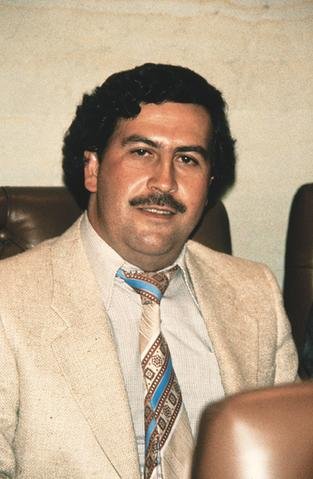
During the 1980s, Pablo Escobar became known internationally as the king of Colombian drug wholesalers. Escobar’s drug network; El Cartel de Medellín, is said to have controlled eighty percent of the drugs that entered into the United States . Escobar became so rich and powerful in the drug business that in 1989, Forbes magazine listed him as the seventh richest man in world. Escobar, on top of being one of the world’s richest men, is also considered to be one of the most brutally cruel men in Columbian history.
Escobar, born in Medellín, the second largest city in Colombia, started off as a small time gangster and a car thief. His small time crimes would never amount to what he was going to become. In the late 1970's Escobar and his cartel began to rise as one of the most powerful organized crime organizations. The cartel consolidated the cocaine industry controlling as much as 80 percent of cocaine worldwide . In 1986 he attempted to enter Columbian politics, even offering to pay off the nation's $10 billion national debt . Kelly Fuller states, “Escobar was shipping as much as 10,000 kilos per flight of cocaine in converted jetliners to America.” The constant flow of drugs caused havoc for local and federal police in the United States. A former Mississippi Drug Enforcement, officer states that, “We would know a large number of drugs were coming in from Columbia.” He goes on to say, “in Mississippi the number one drug was crack cocaine which required the purest form of cocaine in order to have an effective product.” Escobar had risen from small time crook to one of the worlds most powerful men. His power and vicious ways would make him feared by everyone.
The Columbian government drew the line when one of Escobar's bombs brought down an Avianca Airliner in Colombia in November 1989, killing 107 people, and Escobar’s assassination of a popular Columbian Presidential candidate. With these actions, Escobar went from the world’s most powerful Cocaine drug lord to one of the world’s most feared terrorists. The Columbian government, unable to capture Escobar for two years, summoned for American help. American President George Bush Sr. sent help in the form of American Special operation Soldiers called Delta Force
For the next 17 months, Escobar was on the run from not only Columbian authorities but American Delta forces which had brought highly advanced surveillance equipment to track down Escobar . Escobar’s main rivals, the Cali cartel, also wanted to see Escobar disposed of, a move which would make them the largest cocaine traffickers in the world . Aside from the government, a new threat to Pablo Escobar emerged. A vigilante group of people who had been personally victimized by Escobar, or had had a loved one who was made to suffer Escobar’s wrath cropped up in Medellín, and they used the same tactics Escobar himself had used, including the torture of Escobar’s closest friends and family and the destruction of Escobar’s property. This group called themselves Los Pepes, an acronym for People Persecuted by Pablo Escobar . In an attempt to escape the violence, Escobar’s wife and children tried to flee to the United States, but they were refused at customs, and their visas were revoked. Escobar spent every night in a different safe house that he had established around Medellín. He couldn’t talk to his family for more than 3 minutes because if he did so, he could potentially be tracked down.
Escobar’s constant worrying over his family’s safety is what ultimately caused his death. On December 2nd, 1993, Columbia’s special police task force, the Search Bloc, along with American Delta Forces, intercepted a call from Escobar to his son. The origin of the equipment used to track down Escobar is disputed, with some saying it came from the American government, and some saying it was donated to the Columbian government by the Cali cartel . Author Mark Bowden doubts if the Columbian government had any involvement with the death of Pablo Escobar. The sensitive search equipment discovered Escobar in one of his safe houses, armed with only one bodyguard and two guns . He engaged the police in a rooftop bloodbath as he tried to escape, but was unsuccessful. Escobar was shot right below the ear, rendering him dead .
The death of Pablo Escobar was celebrated as a landmark victory in the war on drugs and narco-terrorism. This is the story of what happened when the Colombian government asked the United States to help hunt him down. But in reality, Escobar’s death did little to slow down the fast pace of cocaine trafficking. Escobar’s death might have even helped to increase international drug trafficking. Escobar was well-known for maintaining strict control of the Columbian cocaine industry and for maintaining impossible entry barriers into the business which he dominated. After he died, the Columbian drug scene once again became a free-for-all. Despite the new Colombian drug problems it was a great victory for American and Columbian relations. The American Columbian partnerships against drugs continue till this day.
Kelly Fuller, Hunt for Pablo Escobar. (New York: Oxford University Press,1988), 280.
Ibid, 18. Ibid, 245